Hands-On Lab Episode 5: VATA Wound Care Task Trainers
Feb 9th 2026
Anatomy Warehouse Hands-On Lab Episode 5: VATA Wound Care Task Trainers
Liz:
Hello, everyone, and welcome back to the Hands-On Lab. I'm Liz from Anatomy Warehouse, and I'm thrilled that you're joining us for another episode where we're going to be doing a deep dive into the hands-on tools we love to equip customers with. In our last episode, we explored the SAM4 Auscultation Simulator from 3B Scientific, highlighting its incredible high-quality cardiac and bowel sounds. If you haven't seen that episode yet, go check it out. But for today, we're going to be covering another category of hands-on products, the exciting lineup of wound care task trainers from VATA.
Wound care training is critical in healthcare education. With an aging population and expanding demands on wound management, now is the time to invest in models that level up learning in this critical area. Why? Because effective wound management improves patient outcomes. It can be the difference between saving a limb or even a life. Improved wound care training devices drive outcomes that directly impact healthcare costs. Improved wound care training affects the quality of life of patients and their families.
It's not a glamorous part of healthcare, and it can be really difficult to learn. So the models that we're exploring today aren't just static displays that sit on a table. They're interactive, realistic training tools that replicate real clinical conditions. Whether you're teaching wound staging, dressing application, or patient communication and sensitivity, these models offer a realistic and repeatable way to bring key sets of patient care skills into your sim lab.
Later on today, we're going to hear directly from a team at Vata who helped develop these trainers. They're a great team who's super passionate about making top-quality products, and they're also a genuinely nice group of people we love working with. But for right now, I'm going to welcome our friends and colleagues Mike and Anna to take it away and show us all the great task trainers that we've got here on the table. Anna, Mike, come on in. Thanks so much, Liz.
Mike:
Thanks, Liz. We have a great show for you today with some incredible products from Vata here. So let's get right into it. We've picked out three models here today. The Vinny-Venous Insufficiency Leg Model, C-more 2 Wound Care Model, and the Wilma Wound Foot Model. But we're going to talk about Vinny over here. This one really sets the tone for what hands-on wound and vascular models can do.
What's remarkable here is that Vinny was molded from an actual patient, giving it an exceptionally realistic appearance. It doesn't just show one wound type either. It demonstrates a whole spectrum of vascular and wound-related conditions on the lower leg and foot. On this model, you'll see venous ulcers, stasis dermatitis, varicose veins, hemocaterin staining, lipoderma tusclerosus, and calciflaxis, and pyoderma gangrenosum. The model features a swivel feature at the top so that you can rotate the leg 360 degrees for full visual access, which is useful when you're teaching bandaging or compression wrapping.
Anna:
Exactly, Mike. From an education perspective, this means that students get to see realistic progression and a variety of vascular pathology all in one model. For example, we can see widened blood vessels in the skin and reticular veins, pitting edema and fluid buildup with real rebound, healed foot ulcers alongside active ones, and fungal thickened toenails and maceration alongside diabetic ulcer components.
These visuals make Vinny ideal for competency-based training. It allows students to assess the wound, wrap for compression, change dressings, and compare healed and new wounds, and then learn how each wound type might govern a different treatment pathway.
Mike:
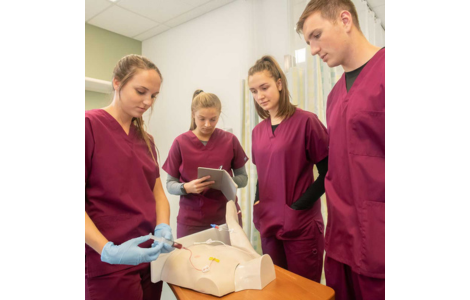
Next, we'll talk about the Seymour Toon wound care model. This is practically a wound lab in one torso. It was molded from a real 74-year-old patient and offers a flexible, lifelike surface designed to support wound dressing and even negative pressure wound therapy. It includes multiple wound types, pressure ulcers at varying stages, undermining, tunneling, slough, granulation, all in one trainer.
Anna:
Right. And from a skill station standpoint, Seymour Toon is powerful because students can practice measuring wound length and depth, staging pressure injuries, applying dressings, using irrigation, even dressing removal. It's ideal for simulation labs where you want students to manage multiple wound types and compare treatment approaches like surgical wounds versus diabetic ulcers versus pressure injuries without needing different physical units for each scenario.
Mike:
And last but not least, we've got the Wilma wound foot model. This is a specialized foot model crafted from an 80-year-old patient for true to life realism. It represents 17 to 20 different wound and pathological conditions in one compact foot unit. Here, you'll find stage one pressure injury on the medial malleus, stage four ulcers with exposed tendon and bone, diabetic neuropathic ulcers, calluses, an amputated toe, dry gangrene, mass aeration between toes, an ingrown toenail, fungal thickened nails, blister, hammer toes. The list really goes on.
Anna:
Exactly. This foot is a hotspot for complex wound care, especially in elder diabetes and long-term care. Wilma allows students to identify wound etiology, stage accurately, clean and dress the wound and one model. The toes move for better access and the materials are durable for repeated use. The base stand also stabilizes this model in an anatomical position so students can work and study.
When used together, Vinny, Seymour too, and Wilma, you have a complete wound and vascular training system that spans lower limb venous pathology. General wound care across torsos and specialized foot care for diabetic individuals.
Mike:
So how do educators integrate these models into their curriculum? So let's talk about the applications across the spectrum from the fundamentals to advanced competency. First, these models serve foundational teaching for nursing, wound care, certification, and allied health programs. Starting with proper wound staging, students look at Vinny's leg and identify stasis dermatitis, lipodermatosclerosis, and healed ulcers. Then move to compression wrapping and bandage changes. This builds the understanding of venous insufficiency, edema, and ulcer etiology in a way textbooks alone can't provide.
Anna:
Absolutely. Next, these are great skill stations for OSCEs. With Seymour too, you can set up multiple wound stations and have students practice cleaning a stage 2 pressure ulcer, measuring and documenting a tunneling wound, applying a negative pressure dressing, and then moving to a diabetic foot model like Wilma for staging and dressing. Because each model is replaceable and consistent, each student gets the same scenario and that's key for fair assessment.
Mike:
They also support interprofessional education. Wound care often involves nurses, physical therapists, podiatrists, and educators simultaneously. Wilma's foot model is the obvious choice in podiatry and geriatric settings, showing how neuropathy, ischema, and pressure combine. Students from different disciplines can collaborate on assessment and offloading strategies.
Anna:
From a logistics standpoint, these models are durable, they're easy to sanitize, and reusable. No live patients, no scheduling conflicts, no ethical concerns. That makes them perfect for repeated lab use or simulation days. They also serve well in patient education settings to help patients visualize what happens with unmanaged peripheral vascular disease, and thereby hopefully improve compliance with compression therapy.
Mike:
And there's a big benefit around competency tracking and confidence building. Instructors report that students exposed to these real-world models enter clinical rotations more prepared. They're quicker at identifying wound types, selecting correct dressings, and explaining care plans. By contrast, students who only use photos or 2D models often struggle with spatial relationships or wound depth and their complexity.
Anna:
In summary, these models streamline training, enhance realism, and improve patient outcomes. They're scalable for small classes or large simulation labs. They bridge the gap between theory and clinical practice in wound care and vascular care.
Mike:
All right, let's get hands-on with one of our newest models in the Anatomy Warehouse lineup, the Vinny Venus Insufficiency Leg Model from Vata. This model was molded from a real patient with chronic venous disease, which gives it the incredible lifelike look and texture. You can see the skin discoloration, the varicose veins, and the open ulcers along the medial side of the lower leg, all of which are common long-term venous insufficiency.
Anna:
Exactly. And what's great about Vinny is that it shows the full spectrum of venous pathology in one convenient model. You've got stasis dermatitis and hyperpigmentation from chronic pooling, edema, and lipodermatosclerosis, which makes the skin appear tight and shiny. And down here, a realistic venous ulcer surrounded by hemocentric staining. Each wound is carefully color-layered and soft to the touch, even has that gentle give when you press, just like real tissue.
Mike:
Right, and before we start wrapping, let's talk about why compression is so important. In venous insufficiency, blood is not returning efficiently back to the heart. The valves in the veins don't close properly, and it creates a pressure buildup in the lower leg. Compression therapy helps reduce that pressure, improve circulation, and promote the healing of the ulcers that appear.
Anna:
Now for teaching purposes, this is a perfect setup. This model attaches to a swivel base so instructors can rotate 360 degrees, great for showing technique from multiple angles. And because the material is durable and latex-free, you can use real compression wraps, ointments, cohesive bandages, even multi-layer systems without damaging the surface.
Mike:
So let's demonstrate a multi-layer compression wrap, which is the standard approach for venous insufficiency. Cool.
Anna:
So our first step is going to be preparing the leg by cleaning and dressing any open wounds with a non-stick dressing. Then Mike is going to work on applying a soft padding layer to prevent irritation and protect the bony prominences like the ankle and the shin. This is going to prevent tissue death later on.
Step three is optional, but if you have some, apply a zinc oxide if there are ulcers present on the leg. This keeps the wound moist to aid healing. So step four is to apply a high-stretch elastic bandage, beginning at the base of the toes. And you'll notice Mike is overlapping about half the width of the wrap each time, working up from the toes all the way to the knee. Notice how Mike's keeping a consistent overlap and tension the whole time. That's key for a good wrap.
We'll follow it up with a cohesive outer bandage later on, and that's going to provide graduated compression, tighter at the ankle and looser as we move upward. That even distribution prevents gapping or bulging that could compromise the compression. Students can practice this multiple times, as Vinny's skin can handle dozens of applications. So as you can see, we're starting kind of with a pre-wrap, and then Mike is going to go in with a real cohesive bandage.
Mike:
So we've got our padded part already done with very consistent compression around. And now you take your more elastic band and you wrap once more.
Anna:
And Mike's going to use the same technique that he did with the pre-wrap. He's going to overlap about half the width of the bandage each time to prevent gapping and ensure even tension as he works from the toes all the way up to the knee.
Mike:
And you want to avoid applying this like a tourniquet. You do not want to restrict movement. You just want to add compression so that you are telling that blood to go back to the heart instead of pooling in the leg. I'm being a little more gentle as I move up the leg here. So the pressure is not as ... Thanks, Anna. Yeah. This stuff sure is sticky. And then you get to figure out the small talk with your patient.
Anna:
So, Vin, how are you doing down there?
Mike:
Did you have a good Thanksgiving?
Anna:
I think he did. His vibes are saying yes.
Mike:
Almost done. Just a couple more layers and I would say we are successfully wrapped.
Anna:
Great stuff. We're just going to stick it out to the end and good stuff. Also, take note of the pressure points around the malleus and the tibial crest. These are where extra padding is critical to avoid skin breakdown.
Mike:
Once the wrap's complete, always check your work. Look at the toes. They should be warm and pink, meaning circulation's intact. You can also press lightly on the nail bed to test the capillary reflex. And this is a great opportunity for instructors to kind of pause and quiz their students. How does your compression feel? Is it evenly applied? Do you see any signs of constriction? That kind of active feedback helps students link what they see to what they feel.
Anna:
And beyond compression practice, Vinny is great for visual learning. Students can compare healthy areas to ulcerated regions, identify early warning signs like edema or skin thickening, and discuss how long-term venous disease can lead to these changes. It's also an incredible tool for patient education, showing patients what happens if the compression or elevation isn't maintained.
Mike:
Exactly. And instead of explaining it abstractly, you can just show them. Here's where the fluid builds up, here's what happens when the valves fail, and here's how compression reverses that pressure, creates a complex vascular condition into something visual and understandable.
Anna:
So to sum it up, Vinny the venous insufficiency leg model helps instructors teach proper compression and wrapping techniques, wound assessment and documentation, edema control and pressure management, and patient education for chronic venous care. It's durable, realistic, and a must-have for any wound care training setting.
Mike:
Well said. The model doesn't just simulate disease, it builds real clinical confidence. And that's what Hands-on Lab is all about, learning by doing. Thanks for joining us for that demonstration. Now, let's hear from Andrew Call from Vata, as he answers some questions about these incredible products.
Andrew:
Hi, I'm Andrew with Vata, and today, along with the Navity Warehouse, I'm going to go over three of our different wound care products, our Wilma wound foot, our Seymour wound care model, and then our Vinny venous insufficiency leg. On each of these products, we get several questions repeatedly, so I'm going to go over those today, as well as just some general information about the products and how they may be able to help you out.
One of the things we always get asked is, how can these products help, and how are our current customers getting value out of these products? I think one of the things that we hear a lot from our customers on how all of these products can be used is that it's really going to help people get that hands-on learning experience. So rather than seeing an image of a stage four wound, like this one on the Seymour, you're going to actually be able to see that model, that wound in three dimensions. You're going to see length, width, and depth, things that you're not going to see in a picture, such as the undermining or tunneling you're going to see.
You're also going to be able to get things like on the Vinny, where you have pinionema, and you're going to have areas that are going to be really soft, or areas like the eschar, which are going to add a firmer, rougher texture to it. You're going to actually be able to see those. You're going to see the size of the wounds, and all of this really helps people grasp this on the concepts quicker, and then they're able to go and do the learning.
So on these ones, it's going to be, how do you put dressings onto different wounds? How do you get a dressing onto the heel, on the foot? And being able to actually practice doing that is going to be something that's going to just accelerate their learning and get them from somebody who is getting the basic concepts to somebody that's ready to start applying that in a clinical setting much quicker.
What kind of materials do we use, and what kind of design choices do we have when we're making these models so that they can hold up to repeated use? The biggest thing is going to be on these models in particular, because they're expected to be able to have wound care dressings put on the models over and over again, over years and years of use, is going to be the basic material the model is made out of. For our wound care products, we use the same material on everything. That is a material that we've determined does a great job over years and years of repeated use. We've changed the material on our Seamore, for instance, over the years to update it. And with our current material, our customers are getting 10 plus years with the models if they're taking care of them correctly.
So the model is going to withstand you putting a dressing on, taking it off, doing that on a daily basis, week after week, year after year. And that's going to be really important both to us, because we wanted to deliver a quality product to our end users, and it's going to matter to our customers a lot because they're going to want a model that lasts. They're putting an investment into these models, and as a result, you want something that's going to last you for years and years. And with these models, you're going to get that out of them.
With each one of these, you're going to get different wounds. You're going to see different things on them. And one of the things that's going to be important is, are people seeing these in the clinical setting? How do you transfer what you're seeing on this to value with your actual patients? And the thing is, wounds like these are unfortunately extremely common. You're seeing them a lot with people, especially when you get later stages of life, or people that have various conditions such as diabetes. They're going to be more susceptible to the things on the foot here. Anyone that's bedridden, they are going to have a much higher risk for a pressure injury. C-more does a great job of showing you those different wounds. And with the venous, that's going to do stuff with, if you have that venous insufficiency, that's going to lead to potential complications and some of the various conditions that you see on the leg.
So these are real scenarios that wound care nurses in particular are going to see, they're prepared for that. In addition to the wound care nurses, we're going to be the primary person caring for that patient. This is going to be a good introduction to the doctors that are involved in that care as well. And then also some of the medical assistants, they are maybe not going to be involved in putting dressings on and all that, but they're going to be involved with taking care of that patient, interacting with that patient. So as long as they have a basic overview, that's going to be really valuable both to them and then to the patient as well.
As we look at these models, we look at the development of them. What does that entail and how do we do that? I think when you go back to our first model, which was a previous version of our C-more, that's going to really come from what is there a need for the product and where does that need come from? How do we figure out there's a need? That can be from something that we observe through processes changing and we anticipate it. It can be from our customer base telling us, hey, it'd be nice if there was a model that did this. It'd be nice if there was a model that had pressure injuries on it so that we could work on staging.
And then once you do that, you really look at is there a need out there? Is it just a handful of people asking for this or is there an industry-wide need? And then as we determine that there is a need, then it's really going back to those same, in our instance, the clinicians, the nurses, and saying, okay, if we're going to make this model, what does it need to have on it? If we're going to make a foot, what should it look like?
If you go to our foot, one of our early prototypes was based off of a healthy foot of, I think, around a 30-year-old at the time. And basically, clinicians said, we don't see feet that look like that. The feet are older. They have other conditions to them. It doesn't look like a healthy foot. So when we went out to do this foot, and all of these models are molded off of somebody, that's where we start. It's molded foot. This is molded off of somebody's backside. This is molded off of a gentleman's entire leg.
So when we went to the foot, we actually found a foot that looked and had a lot of those conditions. It had the hammer toes already. It had some of the deformity to it of somebody that was much older and that had some foot conditions. So we really want to start with that. We want to make sure that we're starting with a part of the body that's going to look like the patient population. Then we're going to look at what wounds need to be on it. So we're going to, again, rely on those clinicians to give us feedback on both the wounds, in this case, as well as the location of each one of those wounds, and then what can the wound look like.
So if we're looking at, again, any of these wounds, they'll give us reference images. We can use those reference images to kind of start the process of what might this wound look like. And then in-house with our sculptors and artists, they're able to transfer components of each one of those images into a wound that they kind of develop in their head. And after we do that, again, we go back to the clinicians. They give us feedback on changes that need to be made or if something doesn't look accurate, and then we move forward with the process. But at each one of those stages, we're really heavily going to rely on our clinician consultants, our customer base, as they are the people that really have the clinical knowledge and they know what they want to see.
As we look at the development process, I think that also kind of goes hand-in-hand with how have these models evolved over time and how are we seeing things possibly changing going forward? I kind of touched on a little bit of that already. I think as we've gone over time and developments that have happened, some of the big ones so far have been obviously materials. The materials are always changing. The materials are coming onto the market. We work with a great group of material suppliers, and they are constantly letting us know that they have a new material that may work for this function or that function that we have. And so we're bringing those materials in. We evaluate them. We see if there's a fit with something currently. Can we upgrade something? And if not, we put it into kind of our library of products that maybe we can use in the future on some project. We're not going to make a change just because something's new and shiny. We're going to make a change because it's going to deliver a better product to the customer.
So with WoundCare, we made a change to the material years ago, and that was really because we got a material that was significantly more durable and was going to last and was really going to develop the quality and longevity of the product that we wanted to see and that our customers were expecting.
Again, then, as we look past the material, the next one is going to be the wound. So on WoundCare in particular, it's how do you make stuff look more realistic? And that's going to come down to new manufacturing methods. And it's going to come down to a lot of it. It's going to be our staff making sure they're trained. We have a great group of people here. All of these models are handmade. They're hand-painted. So when we're looking at these models, we have to train each one of these people on how do you paint this wound, how do you get it to look realistic, and how do you get the first Seymour made this year and the 500 Seymour made this year to all look the same. So again, there's a long training process for people so that they're able to deliver a quality, consistent product.
And then as we look into the future, I think a lot of the innovation on some of these models is really going to come from the medical world itself. Oftentimes, as we're looking at products and the updates that they need, especially with something like this that really is an established product, it's going to be, is there some new process out there? Is there something that we need to incorporate into the model to help people learn a new product, a new way of treating these wounds, or is there something that we're missing? And that does happen pretty regularly.
Something has been introduced to the market, the way a procedure is done has changed, and we need to evolve the product to fit that. And so with WoundCare, we're constantly attending WoundCare conferences. We're learning what's out there, what's new. And if it doesn't mean that there needs to be a update to Seymour or Roma or Denny, you know, established products, then maybe there's a new product we need to introduce and we need to look at how do we develop a new product because there's this new technology out there that people are using and it's helping patients. So how do we help them learn how to do that quicker?
So again, that those people in school or in the hospital setting can learn that new skill, learn how to use that new product quickly, transfer that knowledge onto the patients, and continuing to improve patient care. So it's really an evolving world all the time in simulation. There's always going to be updates and changes needed. There's going to be new technology developed, and that's what makes this world extremely exciting.
As again, you're looking at these different products and you're trying to determine, well, what product do I need? What do I need in my little WoundCare clinic or what do I need in my nursing school or our hospitals opening up a simulation area or expanding it to include WoundCare? What do I need? I think the first thing, and we always talk to the professor about this, is what are you trying to teach? And let's just start with the basics. What are you trying to get your staff to learn, your students to learn? And then from there, we can really start to develop what products may fit that need.
For us, I think that usually our recommendation is to start with the C-more. It's kind of the base model that's going to give you a general overview and an introduction into WoundCare. You're going to learn different stages of wounds. You're going to learn stage one through four on the pressure injuries. You're going to learn how to measure them. You're going to learn how to stage them. And then they're going to learn how to apply dressings from basic wounds like the stage two or stage one up to the negative pressure on stage four and everything in between. So you're going to get a kind of a wide-ranging education with that.
And then as you want to build out into more of the specialties, then you can get into the foot. The foot's going to be great for anyone dealing with podiatry. It's very popular there. It's also going to be very popular for people that are just in general WoundCare. You're going to have all the stages, stage one through four. There's a total of about 20 different conditions on this foot. So you're going to be able to see all of those different wounds on here, go over all of the different conditions. You have things like I was saying with the feel where you have like a deep tissue injury on the top of the foot that actually has that soft and bobby feel to it. So again, they're going to start to learn those concepts as well.
And then again, you can expand out where if you're dealing with venous insufficiency, then the Vinny is going to be a great foot where you're going to be able to have all these different conditions on there. You're going to have the textural changes on things. People can learn things that feel different. You're going to see the different wounds and start to understand what they're coming from. So again, all of these can fill a need. It's really determining what needs you have. And if you have any questions, we would certainly recommend reaching out to our distributors, such as Anatomy Warehouse. Again, if they're going to have those resources, they're going to be able to help you and walk you through that process of determining what models you need. And again, if you need some models now and you want to get additional models in the future, that's something you can look at as well. And we're happy to help.
So again, these are just some of our products. You can see all of the Bata wound care products on the Anatomy Warehouse website. And if you have any questions, please let us know. Thank you.
Mike:
Thanks again, Andrew and Bata for coming on by. It's always great to hear from our brand partners that create these amazing products. Before we wrap up, though, I'd like to take some questions from the audience.
Anna:
Yeah, I've got them right here. So, Mike, can you use actual dressings and ointments for a model like this? Absolutely.
Mike:
I didn't apply ointments today, but you can definitely apply ointments to the wounds. And then you can use actual dressings like I did today on the leg itself. And any of these products really can support that.
Anna:
Awesome. So you don't have to worry about like the paint layer or like degrading the silicone.
Mike:
Yeah.
Anna:
Great. So what about cleaning and storage between sessions?
Mike:
So if you did apply the ointments, I'd recommend that you use a cloth or a paper towel to wipe up most of that more gooeyness on there. But then to like give it a nice clean, just use a soapy water solution, just as you would do like a sponge bath type of vibe. And clean the leg. Make sure it's dry before you put away to prevent any mold growth.
Anna:
Awesome. So we could just treat this like a real person, basically. Pretty much.
Awesome. So we've already established that we can use real compression techniques and real bandages and ointments with this. But what about debridement techniques?
Mike:
Debridement technique can definitely identify where debridement needs to happen, especially when you've identified decay. But for this model and to keep it sort of preserved.
Anna:
Yeah.
Mike:
To keep it around for longer, I would recommend not actually removing any decay because there's not modules to replace this or anything. This is what you get. So you can definitely identify, but don't actually do any debridement techniques.
Anna:
Got it. As far as accessories go, am I to understand that this is the stand that comes with it? And this is the only accessory that this model comes with?
Mike:
Correct.
Anna:
Got it. Okay. So you can expect stands with these models, but there aren't any parts that you can swap out for these particular ones.
Mike:
Really, the only thing that you'd have to replace are the bandages and the ointments that you're using during your practice session. As you would with a real patient.
Anna:
Exactly. Awesome. Well, that's all the questions that we have from our audience today. Thank you so much for joining us today at this episode of the Hands-On Lab. And we're just going to welcome Liz back for our outro.
Mike:
Thank you.
Liz:
Thanks. Awesome work, guys. You crushed that, as always.
And this is a pretty gnarly topic, so you guys really were brave to dive in deep here. So as we wrap up today's Hands-On Lab, just want to do a quick recap on what we've talked about. The Vinivenous Insufficiency Leg shows all those stages of venous disease progression, and it's super great for vascular education. It's also a reminder, stay walking. C-more 2 wound care model brings 20 unique wound types together for a full clinical training. And it's also one of my favorite product names. I mean, shout out to Vata for that one. And the Wilma Wound Foot focuses on diabetic and pressure ulcers, which is really ideal for teaching wound assessment and care planning.
There's a lot that patients have to deal with when this is what's going on. And it's great that you can teach them how to stay healthy and all the things that they need to do to keep those toes. So together, all of these models give educators a really complete toolkit for teaching super realistic wound management, everything from prevention to treatment, and it's an awesome suite of products that we love to have here at Anatomy Warehouse.
I also want to say a big thank you to Andrew Call from Vata today and to all of you for joining us. If you'd like to learn more about these models, simply check them out on our website, anatomywarehouse.com, or just give us a call, shoot us an email, and one of our great sales reps will set up a dedicated time to do a demo just for you.
Or next month, we're going to have another episode coming in the Hands-On Lab, where we're going to be showcasing a brand new lineup of task trainers from Decent Simulators. They've got a really fresh take on some classics in simulation and really excited to share them soon. So until then, stay curious, stay hands-on. We'll see you next time.
FAQ
Can you use actual dressings and ointments on these models?
Yes, ointments can be applied to the wounds, and you can use real dressings on the models during practice sessions.
How should you clean and store the model between sessions?
Wipe away any ointments with a cloth or paper towel, then clean with a soapy water solution. Make sure the model is dry before storage to prevent mold growth.
Can you perform debridement techniques on the model?
You can identify where debridement would be needed, but it’s recommended not to actually remove material from the wound areas to preserve the model long-term.
What accessories come with the model, and are any parts swappable?
The stand is included. These particular models don’t have swappable modules; you’ll typically only replace consumables like bandages and ointments used during training.
Can you use actual dressings and ointments on these models?
Yes, ointments can be applied to the wounds, and you can use real dressings on the models during practice sessions.
How should you clean and store the model between sessions?
Wipe away any ointments with a cloth or paper towel, then clean with a soapy water solution. Make sure the model is dry before storage to prevent mold growth.
Can you perform debridement techniques on the model?
You can identify where debridement would be needed, but it’s recommended not to actually remove material from the wound areas to preserve the model long-term.
What accessories come with the model, and are any parts swappable?
The stand is included. These particular models don’t have swappable modules; you’ll typically only replace consumables like bandages and ointments used during training.
Why do wound care task trainers improve learning outcomes?
They let learners assess wounds in 3D, practice realistic dressing and wrapping techniques, and repeat the same scenario consistently for skill-building and competency evaluation.
They let learners assess wounds in 3D, practice realistic dressing and wrapping techniques, and repeat the same scenario consistently for skill-building and competency evaluation.
Share: