Hands on Lab Episode 6 - Decent Simulators
Feb 12th 2026
Hands-On Lab Episode 6: Decent Simulators Task Trainers
Liz:
Hey everyone and welcome back to the Hands-On Lab. I'm Liz from Anatomy Warehouse and I'm thrilled that you're joining us for another lesson focused on practical skills training.
Today we're looking at a new product line that we're bringing to Anatomy Warehouse from Decent Simulators.
They're a small dedicated team of designers, engineers, and clinicians who share one goal, to create high quality realistic task trainers that help learners build essential skills in hands-on repeatable manners.
Their philosophy is about making models that are just realistic enough to teach the right skills without unnecessary complexity and keeping them simple, affordable, and easy to repair.
What sets them apart is that they design each simulator around a specific task or procedure and not just general look-alike anatomy.
They work closely with medical professionals to ensure the models reflect real clinical needs and then they test and refine them over and over based on feedback and real world use.
Their range includes not only airway trainers like the ones we've got here on the table but also models for procedures such as cricothyrotomy, IV cannulation, suturing, catheterization, wound packing, and hemorrhage control, essentially covering a wide spectrum of core clinical skills.
We've picked out three essential task trainers from their amazing line of products that help students and clinicians develop core competencies they'll use every day, from securing an airway to accurately inserting for chest drain and working with our most delicate neonatal subjects.
We'll explore how the Airway Management Version 2 task trainer, the Chest Drain task trainer, and the Newborn Airway Management task trainer are all designed to provide high quality repetition and realistic hands-on practice without ever needing to touch a live patient.
Later we'll talk with Max from Decent Simulators to hear how these models are being used in classrooms, skills labs, and professional education settings. So let's get started.
Mike:
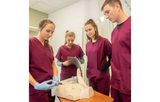
Thanks so much Liz. Now I am so excited to talk about Decent Simulators but first I want to talk about this Airway Management task trainer. It's a Version 2 from Decent Simulators.
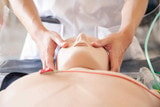
This trainer is designed to build confidence and skill in airway management from basic laryngoscopy to advanced techniques.
The airway is constructed from real MRI and photogrammetry data which means the internal structures respond like real tissue when you insert a laryngoscope or an endotracheal tube. It's been tested against clinical cadavers for lifelike feel and behavior.
One of the standout features is its fully modular design. The airway can be swapped in seconds using a quick release system so you can switch from a standard airway to a difficult airway like angioedema, giving a variety of training scenarios with one model. So cool.
This Version 2 model also supports video laryngoscopy, nasal intubation, and the use of various supraglottic devices. Instructors can teach intubation algorithms, mask ventilation, and fiber optic techniques all on one platform.
Anna:
Next up in our lineup is a specialized airway trainer designed for one of the most delicate patient populations, neonates.
This Newborn Airway Management trainer is from Decent Simulators as well and unlike adult airway models this one is designed specific to the scale of a full-term newborn and it's built to let learners practice neonatal intubation and airway skills with really realistic feedback.
Now what makes this model stand out is how well it mimics actual anatomical and functional features of a newborn's airway. The tongue is soft and flexible, the epiglottis has a realistic omega shape, and the vocal cords are visible without having to overextend the head. The forces required match real life conditions.
Mike:
Exactly, and it allows about 9 centimeters of endotracheal tube insertion to reach that mid-tracheal placement so students can actually learn proper depth and alignment.
The inflatable chest lets instructors show chest rise with ventilation and even demonstrate what happens with right main stem intubation so learners can recognize and then correct that error.
You can use this trainer not just for standard intubation but also to teach proper mask ventilation, nasopharyngeal and oropharyngeal airway placement, and how to adjust technique for a newborn's unique anatomy.
It's modular too so parts can be swapped quickly for replacement or deeper teaching on a specific subskill.
Anna:
The Newborn Airway Trainer is ideal for neonatal resuscitation training, pediatric airway labs, and advanced life support coursework. Students can practice correct positioning, gentle laryngoscopy, and real tube placement without risking a live patient, especially one as delicate as this.
Its realistic airway response and chest rise help learners build muscle memory for fragile patients as well.
And now let's switch gears to something used in emergency thoracic care, the Chest Drain task trainer.
Mike:
This model helps students and clinicians learn needle decompression and chest insertion with lifelike feedback.
This trainer replicates the skin, fat, and muscle layers as you can see here with realistic resistance. The pleural layer is engineered to tear just like it would in a real patient when you puncture it correctly.
You can even pressurize the internal air system so learners hear that natural hiss of air release during needle decompression, a key tactile and auditory cue in real procedures.
One of the smartest features on this model is the rotatable skin. There's no predefined incision marks so students actually have to palpate and learn to identify the landmarks with their own two hands.
You can rotate the skin to expose fresh areas for multiple procedures per consumable. That means more practice with less reset time.
And there's a visible lung component underneath the pleura so you can actually show correct placement and teach recognition of potential complications like lung injury all without needing live tissue or patients.
Plus the key parts are replaceable for long-term classroom use.
With the Chest Drain trainer you can run through the entire emergency chest procedure workflow from landmark identification to needle decompression and tube placement. It's especially powerful in trauma EMS and surgical skill labs where accurate placement and quick recognition of pneumothorax can be life-saving knowledge.
Max:
So realistic enough but no more. Those are not our words. It comes from research on task trainers.
Studies show that low fidelity models just like our task trainers are just as effective as mid fidelity or high fidelity ones.
Even though it kind of feels counterintuitive because lots of people assume that the more realistic something looks the better the training is. But the reality is different and this is why we try to follow the most recent data and we try to focus on learning objectives instead of making the models as realistic as possible for its own sake.
Because it just leads to more expensive models but not more effective ones.
So we try to follow lean manufacturing principles and we work in quick iterations. We design a prototype, work on it as quickly as possible, and then find a clinician in the relevant field to test it, give us some feedback, and then we go through another iteration.
We make some changes, make some small tweaks, create another prototype and go back to the clinician or choose other experts in the field to gather as much feedback as possible.
Every model undergoes five, six iterations until it's usable.
So it involves lots of work and we try to work as quickly as possible and it's a proven method of creating models that are actually functional.
At the same time it's very important for me to understand as much about the procedure as I can myself. So I travel all around the world, literally to Canada, to the US, to Ireland, to Poland, just to learn about different procedures and take part in courses so I can understand everything that goes into some particular model skill involved in the procedure.
Balancing realism and durability is one of the trickiest bits of designing task trainers because the models need to be as functional as possible but at the same time they need to withstand repeated use.
To do that we incorporate different manufacturing techniques. For example we use different textiles together with silicone. We test every model thoroughly and try to discover the points where damage can happen and reinforce it.
But at the same time we need to remember that we are trying to replicate very soft and fragile tissues so it's very important to design the models in a way that they can be very easily and quickly repaired and this is exactly what we are trying to do.
Research shows that training works best when it's adjusted to learners' needs.
This is why everything that we design is modular so different components can be quickly swapped and the difficulty of using the model can be adjusted to the trainee's level. It makes the training more interesting as well and more cost efficient for the educator.
We are a young company but we've already gained a little recognition in the market and we've got lots of happy customers and what's even more important returning customers.
I think the most important thing is the partnerships that we were able to create with clinicians in Canada, Halifax, in the United States, New York, and in Ireland and Poland.
Those collaborations allow us to create new fantastic models and push everything forward.
Our product roadmap is full for years ahead. There are lots of clinicians that come to us with different ideas and we also have our own ideas for next models.
Initially we would like to focus on task trainers but of course we are also thinking about different modalities and simulation.
But the core idea stays the same. The models will always be practical, affordable, and learning objective oriented.
Mike:
Thanks to Max from Decent Simulators for sitting down with us for that conversation. It's always great to hear directly from our team behind these amazing task trainers.
Anna: Totally, Mike. Now let's get into some commonly asked questions about these really cool products.
Mike:
We'd love to.
Anna:
Yeah, so can the Airway Trainer accommodate fiber optic scopes or just direct laryngoscopy?
Mike:
It can support multiple scopes. It supports laryngoscopy and more, the endotracheal tube insertion, but yeah it supports a whole realm of airway training.
Anna:
Amazing. So what accessories are included with this Airway Trainer Version 2?
Mike:
So a lot of accessories actually come with this. You get an awesome bag to carry everything in, and then you also get a lubricant for any silicone repairs.
You also get a spray that allows a realistic airway when you're doing your scoping, and you get a USB that has all of the files that come in your folder. And then also you get these teeth and two airway blockages.
Anna:
Yeah and we know teeth can be really important for these airway management trainers so it's so cool that they come with them and that they break.
Mike:
Absolutely. And I'd like to mention too that this is a kit that comes, but we have an essential version of all of these trainers which just means you get the bag and the trainer. None of these little accessories, which is great for when you want to add another station to your sim lab.
Anna:
Nice. So Mike how are these trainers cleaned for reuse?
Mike:
So cleaning is super easy. The spray is just a lubricant, so you can literally wipe down anything on the outside and rinse anything on the inside with warm water. Wait for it to dry and then you can package it away.
Anna:
Yeah looks like also we can use a diluted soap if we want to with these.
Mike:
Yes.
Anna:
Good to know. So what about replacement parts or consumables?
Mike:
Absolutely. All of these parts, especially since these trainers are modular, you can buy replacement parts for any part of the trainer.
You can buy separates of these, you can buy a separate skin, separate teeth, more blockages. You can even repair just the lungs. If the base cracks you can replace that by itself too.
There's a lot of replacement parts.
Anna:
We were also talking about how you can get in contact with Decent Simulators for different skin variations if you want those too.
Mike:
Yes.
Anna:
Yeah so so much stuff that these things come with.
So when it comes to beginners versus intermediate versus advanced, do you have any insights for us about which models you'd recommend?
Mike:
Absolutely. So I think for beginners, what we don't have today is the Airway Adjunct Task Trainer, which you can find on our website under the same brand Decent Simulators.
The Airway Adjunct is just a mouth to neck trainer that allows you to practice, especially for a beginner, just the insertion of a laryngoscope.
And I'd say for intermediate, once you've got that placement down, you really want to move into the actual procedure. So I'd recommend the V2 of this Airway Trainer.
And then once you're kind of advanced and you're like okay I feel comfortable with my skills here, I want a harder airway, you can replace it for a more advanced feel. It's got a thicker tongue, a more narrow airway that makes it harder to do those procedures.
Anna:
Nice. Wow.
So I understand that we also have a replacement demonstration that we're going to do to show our audience today how we can hot swap these different laryngoscope situations out for each other in real time.
Mike:
Absolutely.
So let's say I feel really comfortable with what I've done with this trainer as is, with the standard airway. And now I want to kind of level up my skills a little bit with this advanced airway.
So always start from the neck here. Peel that skin just like you'd peel a clementine.
Anna:
Yeah we were comparing it to a cutie earlier.
Mike:
A terrifying cutie.
Yeah and then start again from the bottom. Disconnect your lungs from the airway. Easy peasy. And just work your way up.
This part requires a little bit more force, but you kind of want that snug if you're intubating anything.
Anna:
Yeah this does take a little. Just wiggle it a little just to inch it out. But it does come out if you don't mind.
Mike:
Absolutely. Thank you.
And then to install you just go in reverse order.
So we're going to insert this part first. Use a little bit of force. Install the jaw. Line up your airway and then connect to the lungs.
And it's really like Legos. Just snap it in place and slide it in like a credit card.
Anna:
Yeah.
Mike:
And then the skin. And you're not going to start at the neck. You're going to start at the head.
Anna:
Nice. I'm seeing it just connects. And there's these little nubs that you insert into the hole and then press in and it shouldn't come out. And you'll just do that across the whole thing.
Lovely. And there you have it folks.
Mike:
Awesome.
Anna:
Well thanks so much for joining us today at the Hands-On Lab. Mike and I have had a blast presenting these amazing new simulators to you.
We're going to kick it back to Liz for our outro.
Thanks so much for joining us guys. Thanks y'all. Bye.
Liz:
As we wrap up today's Hands-On Lab let's recap.
The Airway Management Trainer Version 2 lets students practice on a modular realistic platform for mastering core and advanced airway skills.
The Newborn Airway Management Trainer lets students learn on neonatal subjects in critical life-saving procedures in an easily repeatable environment.
The Chest Drain Trainer prepares students to practice repeatable airway decompressions with real-life feedback.
And I want to say thank you so much to Max from Decent Simulators and to all of you for attending today's session.
If you'd like more information, pricing, or a quote on any of today's trainers from the entire Decent Simulators lineup, just visit anatomywarehouse.com or reach out to our team.
Don't miss our next episode where we're going to be showing off Medical X and their awesome line of products.
So until then stay curious, stay confident, and as always stay Hands-On!
Share: