
Hands On Lab Episode 7
Jun 1st 2026
Hands-On Lab Episode 7: Nursing Bundles
Liz:
Welcome back to the Hands-On Lab. It's great to have you back. My name is Liz.
I am the CEO of Anatomy Warehouse, and I'll keep my intro short today because the product selection is where today gets really exciting. Here's what we believe. Clinical confidence comes from repetition, and repetition requires the right tools.
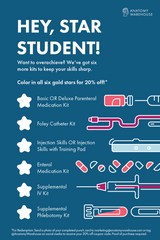
Nursing students can read about venipuncture, they can watch a demonstration, they can take a quiz, but none of that replaces actually doing it with real supplies through real procedure sequence, and that's what our Anatomy Lab nursing kits are built all around. Today, Mike and Anna are going to walk you through six of those kits and what's in each of those kits, what skills it supports, and how it fits into your nursing curriculum. So we'll leave a little time at the end for Q&A and get excited to bring those questions.
Take it away, Mike and Anna.
Mike:
Thanks, Liz. I'm Mike, and this is Anna. Together, we're going to walk through six Anatomy Lab nursing kits today, what's in each one, what skills it supports, and how it fits into a simulation curriculum.
We'll start with the two supplemental kits, which are designed to pair with task trainers that you likely already have, then move into the skill-specific bundles. Let's get into it. First up is the Anatomy Lab Supplemental Phlebotomy Kit.
This one is exactly what it sounds like, a supplemental kit. It's designed to be paired with a phlebotomy arm or ventipuncture trainer, like the Anatomy Lab Ventipuncture and IV Practice Arm, giving students the actual consumable supplies they need to practice realistic procedures. So what's in the kit?
You're looking at a full range of blood collection supplies, vacuum tubes, and multiple additives, including EDTA, sodium citrate, serum clot activator, and sodium heparin, plus transfer needles, butterfly needles with extension tubing, blood collection holders, and multiple lure lock syringes. There's also a tourniquet, alcohol prep pads, gauze, a sharps container, biohazard specimen bags, patient ID band, a cohesive wrap, and gloves. Everything you need.
Anna:
What I really like about this kit from a curriculum standpoint is how much ground it covers. Students can practice the full ventipuncture sequence, patient prep, aseptic technique, needle handling, blood draw, specimen labeling, and safe sharps disposal. You've got the right tube types in there to walk through tube order of draw, which is one of those things that students need to do repeatedly before it becomes second nature.
It's a great fit for nursing programs, medical assistant programs, and EMT courses. And because it's designed for repeated use in a classroom or a sim lab setting, the value holds up across multiple students and sessions. Sticking with the supplemental theme, next we have the anatomy lab supplemental IV kit.
This one focuses specifically on intravenous access and IV therapy skills. The kit includes IV catheters across multiple gauges, 24, 22, 20, and 18 gauge, which is important because students need exposure to the full size range. You'll also find IV tubing and extension sets, a lure adapter, a pre-filled normal saline flush, a 10 milliliter luer lock syringe, IV start kits with chloroprep, adhesive remover pads, cohesive wrap, a patient ID band, absorbent pads, gauze, and gloves.
Mike:
From a skills perspective, this supports peripheral IV insertion practice, site preparation, flushing and locking an IV line, and catheter securing. The inclusion of multiple catheter gauges is a detail worth highlighting. Students need to understand gauge selection based on clinical context, and having all them in one kit lets you build those decision-making conversations right into lab time.
It pairs really well with most IV arm trainers or venipuncture mannequins. If your program already has a test trainer, this kit keeps it running with consumables that match real clinical supply. Now let's shift into the anatomy lab injection nursing skills training kit.
This is a foundational kit for any nursing programs covering parenteral medication administration. Inside, you've got a comprehensive selection of hypodermic needles, 18, 22, 25, and 27 gauges, along with blunt fill needles, an insulin syringe with attached needle, and multiple lure lock syringes in 1, 3, and 5 milliliter sizes. There's also a glass vaccine syringe with a blunt fill needle, which is a nice touch for programs covering immunization techniques.
On the medication side, you've got practice vials in multiple sizes, 1, 2, 5, and 10 milliliters designed specifically for training use. Rounding it out are alcohol prep pads, gauze pads, bandages, hand sanitizing wipes, a sharps container, medication labels, and gloves.
Anna:
Injection technique is one of those core competencies that students have to get right before they ever touch a real patient. This kit gives them everything they need to build that muscle memory. We're talking subcutaneous injection techniques, intradermal, intramuscular.
Students can work through needle selection, angle of insertion, aspiration technique, and safe disposal all in one lab session. The practice vials are a great addition because students can also work on drawing up medications accurately and reading syringe measurements, which is something that gets skipped over when programs only focus on the injection itself. The full picture includes prep, and the kit covers it.
This kit comes in two variations, one with just the injection skills, and one that comes with an additional injection pad included to create an all-in-one kit to use straight out of the box. Moving on to the Anatomy Lab Enteral Medication Preparation Kit. Enteral medication delivery is a skill area that sometimes gets less lab time than it deserves, so we really appreciate that the skills kit exists as a dedicated bundle.
This one covers oral and tube-based medication administration from multiple angles. You've got medication cups, a pill crusher, a splitter, an oral liquid medication bottle, oral syringes in 1, 5, and 20 milliliter sizes, and irrigation syringe. On the practice medication side, there are caplets, scored caplets, tablets, and demo dose pills in a prescription bottle.
For tube feeding and nasogastric work, the kit includes a nasogastric tube and an oxygenation trainer, as well as a radioplaque stomach tube, a gastric tube, extension port, a pH test strip, sterile lubricating jelly, and a nasal and silk tape. It's also stocked with the standard PPE and safety supplies, gloves, wipes, and an absorbent pad.
Mike:
What makes this kit stand out is the range of enteral delivery methods it supports. Students can practice oral medication administration, including proper crushing technique for patients who can't swallow whole tablets, as well as a nasogastric tube medication delivery. The pH strip is for confirming tube placement in a meaningful clinical detail.
That's a real patient safety step, and having students practice it in a simulation is exactly where that habit should be formed. There's also a lot of flexibility here for instructors. You can run a focused lab on pill crushing and oral administration on one day, and use the NG tube components for a separate session on another day for tube feeding care.
The kit supports both. Next up is the Anatomy Lab Deluxe Parenteral Medication Preparation Kit, and this one is worth spending some time on because it's a significant step up from our basic injection or the vial drawing kit. This is a comprehensive parenteral medication prep bundle built for programs that want to cover the full scope of IV medication preparation and delivery, not just the injection itself.
The contents span two tiers. On the foundational side, you've got an IV injection training pad, practice ampules in 1 and 5 milliliter sizes. Both are tinted and clear.
Amp safety breakers for proper ampule opening technique, filter needles and blunt fill needles, lure lock syringes in 1, 3, 5, and 10 milliliter, and a full range of practice vials, including a powdered reconstitution vial in yellow, a water vial, and a standard 1 and 5 milliliter vial. There's also an IV tubing extension set, absorbent pad, alcohol prep pads, gauze, a sharps container, medication labels, and gloves. What makes this kit stand out is the range of enteral delivery methods it supports.
Students can practice oral medication administration, including proper crushing technique for patients who can't swallow whole tablets, as well as nasogastric tube medication delivery. The pH strip for confirming tube placement is a meaningful clinical detail. That's a real patient safety step, and having students practice it in a simulation is exactly where that habit should be formed.
There's also a lot of flexibility here for instructors. You can run a focused lab on pill crushing and oral administration on one day, and use the NG tube components for a separate session on a tube feeding care on the next day. The kit supports both.
The deluxe editions are where things really expand. You get an additional powder vial in white at both 10 and 20 milliliter, a 30 milliliter practice vial, and a 50 milliliter and 500 milliliter normal saline practice bag, which is meaningful inclusion because students need to work with full-size IV bags, not just vials. There's also a 20 milliliter syringe, primary IV tubing with two needle-free ports, a secondary IV administration set with a hanger, IV bag labels, IV tubing labels, pre-filled normal saline flushes, an IV fluid stand, transparent adhesive tape, and IV catheters in 20 and 22 gauges.
Anna:
What this kit really enables is end-to-end IV medication preparation training. Students are working through reconstitution of powder medication, labeling, priming a primary line, hanging a piggyback, managing a fluid stand, and practicing catheter insertion. That's a complete clinical workflow, and having all of those supplies in a single kit means instructors can run through the full lab session without hunting down components from multiple sources.
The inclusion of the 500 milliliter saline bag is a particularly useful aspect for programs running IV therapy labs. It allows students to practice spiking a bag, priming tubing, and calculating drip rates with realistic materials. We also offer a basic version of the parenteral kit for those on smaller budgets but still want the full experience.
Last is the anatomy lab fully catheter insertion kit, and it's worth saving to the end because it's the most comprehensive kit in the lineup. It comes with something that the others don't, real anatomical trainers. The kit includes a male and female urinary catheterization and enema trainer, along with a shared base for both.
On the supply side, you get a two-layer fully catheter tray with a drain bag and 100% silicone catheter, an intermittent catheter tray kit, a urine specimen collection kit, a urinary leg drain bag with elastic straps, a sterile syringe, nitrile gloves, hand sanitizing wipes, alcohol prep bags, peri care wipes, an absorbent pad, and a biohazard specimen bag.
Mike:
The fact that both male and female trainers are included is significant. Catheter insertion technique varies considerably between the anatomies, and students need exposure to both. Being able to practice on realistic models, not just conceptually understand the difference, is where this kit really delivers.
The full procedure can be walked through end-to-end patient prep, draping, sterile field setup, catheter insertion, balloon inflation, bag connection, and specimen collection. For nursing programs, this is one of those skills that creates a lot of student anxiety. Having a dedicated kit with realistic trainers gives them the repetitions they need to feel prepared before clinical rotations.
Anna:
Absolutely, and just to wrap up the product selection with a note, what we love about this entire lineup is that these kits are designed to be curriculum aligned. They're not just a random collection of supplies. Each one maps to a specific clinical competency that nursing students are expected to demonstrate.
Whether a program is running in-person labs, a hybrid format, or even just supporting remote learners who need supplies to practice at home, these kits are built to travel and hold up. If any of the kits we've covered today are close to what you need but not quite, we also offer customization. Our team can work with your institution to adjust the kit contents to match your specific curriculum, so don't hesitate to reach out if you want to explore that option.
With that, I'll hand things back over and we'll move to Q&A. So one of the questions that we get a lot is, are these kits appropriate for individual students or are they designed for institutional purchase?
Mike:
It's a very good question, and the answer is both. A lot of our institutional customers, like nursing schools, community colleges, simulation centers, purchase these in bulk for their labs. We offer volume discounts at 50 units and that scales up from there, so the more you buy, the more you're saving.
That said, individual students absolutely purchase these as well, especially for programs that require students to have their own supplies for at-home practice or skill check-offs. The kits are priced excessively with that use case in mind. So question two, can these kits be reused across multiple lab sessions or are they single use?
Anna:
Well, it depends on the kit and the component. The anatomical trainers and the Foley catheter kit, for example, are designed for multiple repeated uses across many sessions. The consumable supplies, catheters, wipes, prep pads, gloves, are single use by nature, just as they would be in a real clinical setting.
For programs running high student volumes, the supplemental kits are a cost-effective way to keep those consumables stocked, and because we carry all of the individual components separately on our site, restocking specific items is very straightforward. So next question, how do these kits align with the standard nursing curriculum frameworks like QSEN and NCLEX competencies?
Mike:
So these kits weren't designed with a specific framework name attached, but the skills that they cover map directly to core NCLEX competency areas, safe medication administration, infection control, patient-centered care, and procedural technique. The induction kit addresses parenteral pharmacology skills. The Foley kit hits urinary care.
The enteral kit covers tube feeding and oral administration. Instructors will recognize the alignment right away. For programs that need to document specific competency coverage, we're happy to work with you on that conversation.
Our team can speak to curriculum fit in more detail. Awesome. Next question, is there flexibility to customize a kit if our program needs something slightly different?
Anna:
Absolutely. If a kit is 90% of what you need, but it's missing one or two components, or if you want to swap something out with a different gauge or size, our team is happy to work with you. We've done custom kit builds for institutions with very specific curriculum requirements, and that process is more accessible than people might expect.
Reaching out through our contact page or requesting a quote is the best way to start that conversation. Next question, what is the lead time on larger institutional orders, and do we accept purchase orders?
Mike:
Very good question. Most of our nursing kits are in stock and ship within one business day for standard orders. For larger institutional orders, especially if customization is involved, we'd recommend connecting with our team ahead of time to confirm lead times and plan accordingly.
And yes, we do accept purchase orders. That's a really common way that universities and healthcare programs work with us, and it's a smooth process on our end.
Anna:
All right. Well, thank you so much for joining us today. And with that, we're going to hand the mic back to Liz.
Liz:
Take it away, Liz. Thanks. Thanks, Mike and Anna.
And thanks to everyone who joined and sent in those great questions. If any of the kits we've covered today are fit for your program, the easiest next step is to just visit anatomywarehouse.com. You can explore our entire lineup, request a quote, or reach out to our team directly if you want to talk through some of the customization, or even potentially place a large bulk order.
We'll be back with another episode soon. Thanks for your time today. And as always, stay curious and stay hands-on.
Share: