Hands on Lab Episode 4: SAM4 Auscultation
Dec 1st 2025
Anatomy Warehouse Webinar Episode 4: SAM4 Auscultation
Liz:
Hey, it's Liz from Anatomy Warehouse and welcome back to another episode of the Hands-On Lab. I'm glad you're joining us for another deep dive into technology shaping the future of medical education. Today we're focusing on one of the most essential skills every healthcare professional must master, auscultation.
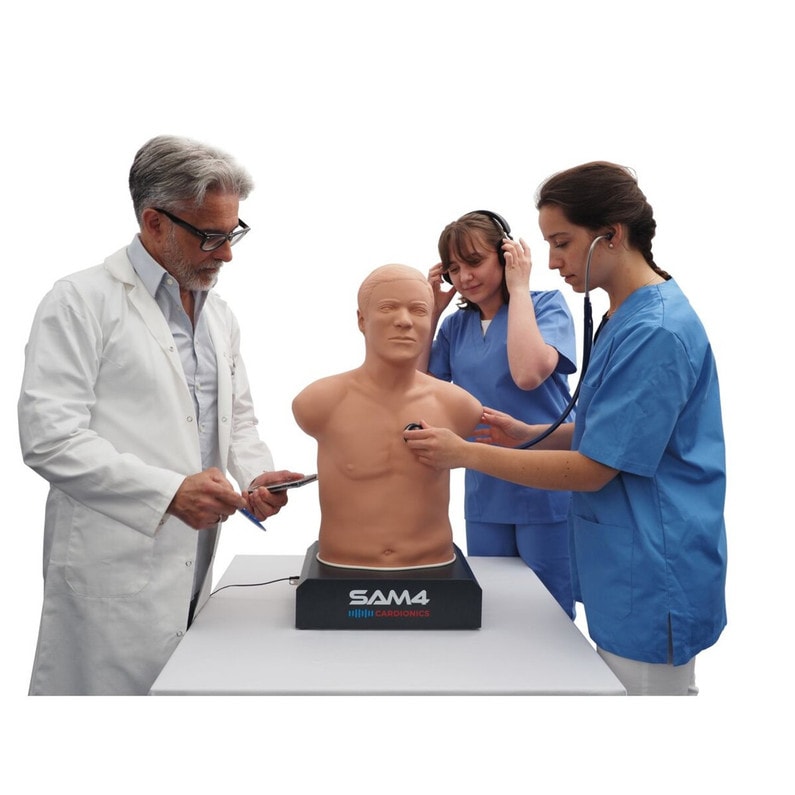
We're doing a deep dive into a training tool that makes it easier than ever to learn this classic skill set, the SAM-4 Auscultation Mannequin from 3B Scientific. So if you've ever taught or learned cardiac and pulmonary assessment, you know how difficult it can be to get consistent exposure to real high quality patient sounds. SAM-4 bridges that gap by giving learners hands-on repeatable practice using authentic sounds recorded from real patients, not synthetic imitations.
Today I'm teaming up with Tim Hemans from 3B Scientific. And in addition to being a genuinely lovely human being, Tim's knowledge of the platform is unmatched. So together, we're going to explore how SAM-4 brings students and educators refined diagnostic listening skills.
And we're going to talk about the impact this product is having in classrooms, labs and sim centers across the country. So let's get started. Welcome to the Hands-On Lab, Tim.
Tim:
Thanks, Liz. Great seeing you. Hey, everyone.
Good morning. It's great to be here. And I really appreciate the opportunity to talk about SAM-4.
Yeah.
Liz:
Well, tell me a little bit about the history of SAM.
Tim:
Yeah.
Liz:
Because he's got a rich history. He does. And we're now on SAM-4, right?
Tim:
Yeah. Yeah. So a lot of you may recognize SAM-4 looking very similar to SAM-2.
And it does on the surface. Those of you who know cardionics in 3B will remember SAM-2, SAM-3G. What we've done over the past 12 months is made some great enhancements, three main enhancements.
You might remember with SAM-2, there was a big bulky laptop and lots of cords, and it was a mess trying to operate it. A little old school. A little old school.
So now we've made it app-based. So I can control SAM-4 from my phone. And then we've also made SAM rotate 360 degrees, which makes it much easier to auscultate anterior and posterior.
And then we've added lighted auscultation points so that in a classroom setting, you can show where the auscultation point is. But then come quiz time, you turn the lights off, and the students have to find it on their own.
Liz:
Got to keep them on their toes a little bit.
Tim:
Got to keep them on their toes. SAM-4 has 89 sounds in the sounds library, heart, lung, bowel, brewery, and heart-lung combination sounds. SAM-4 Plus is the enhanced version, and that has three dynamic sounds, which allows you to change the heart rate, 35 real sounds, and then 12 echocardiogram videos.
So just depending on your needs, SAM-4 or SAM-4 Plus may be a fit. We've had great reception in the marketplace with SAM-4. Great quality of sounds and being app-based just makes it so much more current.
Liz:
Yeah. And I think that's really where Cardionics really shines is the quality of those sounds because they come from real patient data, not sort of made up. This is kind of what AFib sounds like.
This is kind of what a gurgle sounds like.
Tim:
That's exactly right, Liz. That's exactly right.
Liz:
Can we take a look at some of those light-up sites?
Tim:
Yeah.
Liz:
Because I think that's such a fun feature to help students know.
Tim:
Yeah, absolutely. Absolutely.
Liz:
I mean, we've got anatomical models over here, but now we're kind of looking at just the patient presentation. So we can't see where the heart is. We can't see where the bowels are.
We need to learn where we need to point the stethoscope.
Tim:
That's exactly right. That's exactly right. Liz, I have this queued up on my phone.
You can do iOS or Android. Right now, we're playing micro regurgitation. And then I'm going to select a button to turn on the auscultation lights.
Okay. And so when we turn it on.
Liz:
Hey, look at that.
Tim:
I'll turn it off. And then I'll turn it on. And you can see it lights up.
Again, this can be user or instructor controlled in a training scenario. Liz could get some assistance with finding the spot. But come quiz time, we're going to turn that off.
You got to find it on your own.
Liz:
Now I got to really know my stuff. I think I got it.
Tim:
You got it? All right. From a listening perspective, one great thing about SAM4, which is also true with SAM2 and SAM3G, students can use their own stethoscope.
Nice. You don't have to share a simulated stethoscope. You can use your own stethoscope.
You can also in a classroom setting, you can connect SAM4 to a Bluetooth speaker.
Liz:
I think we've got one hanging out here.
Tim:
Yeah, here we go. You can connect it to a Bluetooth speaker or students can use headphones. Oh.
So just depending on the training environment that you'd like to set up, I think we can accommodate either individual needs or in a classroom setting, being able to amplify the sounds to teach in that type of learning environment.
Liz:
Yeah. And I think what's great is there's such a wide library of sounds. Maybe you could tell me a bit about some of the feedback that you guys get and that we get about the quality of those sounds and the ease of accessing them in the library.
Tim:
Yeah. Again, there's 89 total sounds with SAM4 and SAM4+, heart, lung, bowel, brewery, and some heart-lung combination sounds. All of the sounds are based on actual patient sounds that have been recorded, cleaned up a little bit in SAM4.
SAM4+, has the true actual sounds with the noise. So you've got to sort through and really pinpoint the sounds. But we get incredibly positive feedback about the quality of the auscultation sounds for all of the Cardionics products, most especially SAM4.
Yeah.
Liz:
And I think it's cool with the plus that you guys include the noise in there, because when you really get into it as a student and into the practice, you got to be able to cut through the noise.
Tim:
Absolutely. If I'm studying to be a cardiologist, I got to be able to listen through the noise to hear a murmur or microaggregation or AFib. So, yeah, we're really excited.
As a side note, we do have a pediatric version, Liz. Tell me about it. Of SAM.
So PAT4 has replaced the PAT that many of you may recognize, a pediatric auscultation trainer. Just a smaller size version of SAM4 operates on the same principle, app-based 360 degree torsional rotation and lighted auscultation points. So it was a great enhancement as we did with SAM4.
We've done the same with PAT4. Both mannequins are available in light and dark skin tone.
Liz:
Oh, that's great. I love that. I'm curious with the students who are coming into a program and have no background in the auscultation practice, how easy is it for the students to start to memorize these sounds?
Because I think that's such an important part of this skill.
Tim:
First of all, this is really plug and play. A student can just grab a stethoscope and start listening. We can combine this with, we do have another option, is SAM4 Online, which is a cloud-based auscultation platform, which is a great learning tool for students where they can have really 24-7 access to an auscultation library.
So there they can help continue to build their knowledge when they don't have access in the Sim Lab.
Liz:
So instead of listening to Spotify while they're doing their work, they can listen to heart murmurs and vowel sounds and really get immersed in the sound of the body.
Tim:
They can truly rock on to heart sounds. Exactly. Sometimes when I'm at conferences, I'll have this cranked up, some beat sound.
Just, you know, it draws attention, but it also again shows the quality of the heart sounds.
Liz:
When those cardiologists walk by, they really recognize it. I know that one. Tell me a bit about the types of pathologies and things that we're looking for, because it's great to learn the healthy sounds, but as a student and really somebody who's getting into cardiology, you've got to be able to understand the difference between a healthy heartbeat and an anomaly.
So is there a lot of that kind of baked into the SAM platform?
Tim:
Absolutely. In all the sound categories, heart, lung, bowel, and brewery, we'll have all the different pathologies, you know, AFib, mitral regurgitation, crackles in the lung, which is really what we want students to train on. We don't want them to just know what a healthy heart sounds like.
We want them to be able to identify pathologies, abnormalities that will then lead to the next step in a diagnosis and treatment, which is really, I think, the ultimate goal of all healthcare, right?
Liz:
Yeah. And it's one thing that we're really focused on here at Anatomy Warehouse is hands-on learning. And so the ability to kind of interact with the mannequin, understand not only the placement of the auscultation sites, but the depth of heart sounds, the depth of lung sounds.
I mean, even just learning how COPD sounds, different from other types of pulmonary disorders, so, so important. And that's where really, where the hands-on practice kicks in.
Tim:
Yeah, that's exactly, that's exactly right.
Liz
Hey, Matt, our lovely production manager back there, can we get some questions from the audience going? Tim and I are going to continue to explore more features of SAM, and I've got a ton of questions for you, so get ready, Tim.
Tim:
Yeah, I'm ready.
Liz:
But yeah, audience, come on in, drop some comments, and Matt will whisper them into my ear. I'm not mic'd up, so this will be fun. But yeah, we'll start seeing what you guys have to say.
But I think one of my very first questions is, you know, since this is the first, the fourth generation of SAM, really, how does this compare to other auscultation mannequins and prior versions of SAM in the cardionics history?
Tim:
Yeah, it's really state of the art, and really true of time, if you will, in the environment that we're in. There's not a lot of big, bulky laptops and cords around these days, and we were really happy to make this move. And we're getting a lot of really positive feedback on the ability to connect to SAM on your own device, make the changes, and then the subtle changes, too, of adding the lighted auscultation points, and just a very basic enhancement of being able to rotate this.
Liz:
So simple.
Tim:
Yeah, when you're auscultating anterior and posterior, you don't have to move, right?
Liz:
Are there light-up sights on the back as well?
Tim:
There are. Yeah.
Liz:
And, you know, I'm curious how 3B Scientific and the cardionics team, do you guys ever think about how this shows up in test prep and ways to make sure that it's aligned with things like OSCE or just other clinical assessments?
Tim:
Yeah, yeah, absolutely. I mean, that's our goal, is to provide the tools, training products so that, you know, healthcare students, you know, nursing students, med students have the products that they can use to train on and develop the skills that are going to move them forward in the whole assessment, knowledge, training process. So that's really, it's advancing medical education and simulation through the quality, breadth, and global reach of our products.
Liz:
You guys have a ton of products.
Tim:
We do, we do. And we even have more in the cardionics family. These are SAM4 and SAM4 Plus are kind of the top tier of the products.
But we also have some more entry-level pedestal-based mannequins, SAM Basic and PAT Basic, which operate on a simulated stethoscope system. RFID tags are embedded in the mannequin and you program the SimScope through some software and then students can auscultate. Those are great entry-level products for CTE health science programs in the K-12 market.
And so the next one would then be the SimScope system, which operates just like that SAM Basic and PAT Basic I described. But what it allows you to do is to take a static mannequin or a torso.
Liz:
Hey, I see a 3B scientific torso right here. What can we do with this?
Tim:
And bring it to life.
Liz:
Oh, you've got some of those fun RFID.
Tim:
I love these things.
Liz:
They are so cool because it allows you to kind of bring the auscultation concepts to anything. Tim could put them on me. We could put them on this fun 3B scientific mannequin or torso here.
It's fun because one of the things we love at Anatomy Warehouse, obviously anatomy is in our name. Simulation is a big part of our business as well. But I think it's so cool that we can bring the anatomy and simulation together with a product like these RFID tags.
Let's tag up that torso.
Tim:
So this is the lung, right lower. So if I put that on this torso or I put it on a static mannequin and then took the SimScope, which looks pretty much like a regular stethoscope, program that to listen for crackles in the lung. I could then go over here, auscultate, and I'm going to hear it.
It would work great also in a standardized patient program. We could put these onto a T-shirt or use our SimShirt. And so a standardized patient could truly exhibit heart abnormalities, lung abnormalities by programming the SimScope to play those sounds.
It's really cool.
Liz:
Yeah. And I think what's fun, again, to bring the anatomy back into it is, you know, when you're having students do the auscultation and saying, hey, you know, I'm picking up some lung crackle here. We can take the lung apart and we can dive deeper into the understanding of the anatomical structures and ask questions like, you know, what leads to congestion in the lungs?
What leads to these types of sounds on an anatomical level? So we can really bring both halves of education together between anatomy and Sim. And the RFID tags make that so cool.
Tim:
Absolutely. Absolutely.
Liz:
Matt, do we have any interesting questions coming in yet? All right. Well, I've got plenty more.
Don't sweat it. What's your favorite feature to demo on SAM4? You guys hang out with him.
Tim:
Yeah, I think the lighted auscultation points are really cool. And I like the fact that an instructor can control it. It's not like you turn them on and they have to stay on.
You turn it on as a guide, as an aid, right? Like auscultate here, but then come test time, Liz has got to find it on her own. And then, of course, being app-based is just cool.
I mean, everything's app-based.
Liz:
I remember the bulky laptop days. Open this thing up, plug it in. And I mean, this is it, right?
Tim:
You got cords and everything. And then this isn't a recent change, but being able to use your own stethoscope is just huge. I mean, you're a nursing student or a med student and your parents or someone got you a stethoscope.
Liz:
You want to use it. You don't want to share it. You don't want grandma to be like, I spent all that money on a stethoscope for you and you're not even using it.
Yeah, bring your own stethoscope. I'm curious. Can you tell me anything about what's coming up next for Cardionics and any future development?
Obviously, you guys have really upped your game with this one. So I'm not even sure what you guys can do after this.
Tim:
Yeah, I mean, I think we're always looking for ways of incorporating our products into other products, right? One example of that, this is an upcoming, it's already happened, but one of our top selling simulation products worldwide is our patient care mannequin, basic and pro.
Liz:
The Nikki?
Tim:
Well, that became Nikki. So what we did after the acquisition of Cardionics, we took the chest plate of Nikki, which is a nursing skills patient care mannequin, put RFID tags in there, and it became Nikki, the auscultation mannequin, on the base of our patient care mannequin, basic and pro. So I love the way we can integrate different products from our different companies.
We've done the same with introducing simulated medications from Walker into maybe an EMS training scenario. So I think that's what we're always looking to do, is providing complete solutions that bring in all those components of a true realistic simulation scenario.
Liz:
Yeah, I love the cross-pollination that you guys have across the 3B scientific family of products and companies, and super clever to kind of bring this and apply it to a full body mannequin. Exciting news, Tim, we have an audience question.
Tim:
Yeah, nice! Thank you, production manager Matt.
Liz:
All right, so somebody from the audience would like to know, what's the differences between the SAM4 models? So there's kind of basic and pro. Tell me about all of them.
Tim:
Yeah, so for SAM4, the base SAM4 has 89 total sounds. It has the auscultation points, the 360 degree rotation. SAM4 plus is the enhanced version.
The three enhancements are three dynamic sounds, which allows you to change the heart rate. 35 real sounds, which again are those sounds that have not been cleaned up.
Liz:
Yeah, the noisy ones.
Tim:
The noisy sounds, right? And then 12 echocardiogram videos.
Liz:
Ooh, and you see those on the app?
Tim:
Yes, you see those on the apps. Now on the app, you'll see a phonocardiogram even with SAM4, a visual representation of the heart sound. But with the enhanced SAM4 plus, you'll see the 12 echocardiogram videos.
Very cool. And they'll be noted by a blue circle indicating that that specific sound has an echocardiogram associated with it.
Liz:
And that shows up on the mannequin, yeah? The blue?
Tim:
Or is that on the app? On the app, just showing you that that specific sound has an echocardiogram tied to it.
Liz:
Got it, got it. And the app is so easy to navigate. And this comes from somebody who barely knows how to use an Android.
Tim:
Yeah, I mean, users can just go in there and they can either download the app or scan the QR code on SAM4 and it's going to prompt them to download the app. And then you click search and it's going to search for the mannequin. You connect to it and within minutes, you're auscultating.
Time is precious when you're a nurse or a nursing student or a med student. You don't want a long connection time. You don't want timeouts.
You want to get in there, get your studies done because you have a limited time in the lab. And then you want to go back and hit the books or hit clinical rotations. And so the simpler we can make the operation of our products, I think the better for students and better for the learning environment.
Liz:
I couldn't agree more. Tell me about how sim centers and sim labs can get multiple SAM set up because I've seen that before.
Tim:
Yeah, yeah. I mean, in this scenario, the device to the mannequin is one-to-one. So, you know, you certainly can use it in a classroom setting with the external speaker.
But you definitely, we have many sim centers that will have multiple SAM4s set up. And, you know, you set up maybe groups of students or groups of instructors. And, you know, I can be the instructor for a group of students.
I can select the sounds and then students can take turn auscultating, listening. And you could do that in pods, if you will. Maybe this pod is focused on heart and heart-lung combos.
This pod is focused on lung sounds. This pod is focused on bowel sounds. And so you can kind of categorize or segment the training based on that.
So it's a great way. And these are very durable. You know, again, just the highest quality heart sounds.
Liz:
Yeah. And I think, you know, the idea of doing station setups with multiple SAM4s sounds great. Because, like you said, the instructor can say, look, we're going to focus, like you said, on heart sounds here and get it going.
And students can work together, ask each other questions, really get collaborative. And then you can move to the next station and it's already set up for the bowel sounds. And you can just keep rotating around and get the full experience by just having multiple SAMs set up in your lab.
Tim:
Yep. And you might, you know, start with the torso. If this is the lung station, you know, we could be oscillating, listening to lung sounds, but then students can see, here's the anatomical structures, right?
And it really brings it full circle. And if there's some specific drugs associated with, you know, pneumonia or something, we could have assimilated drugs. And so we just bring it all together in a full circle, realistic simulation scenario, which I think that that's what students are going to be doing when they get into practice, right?
Liz:
Yeah.
Tim:
It's not like, I'm sorry, I'm just listening to the heart today. No, you're not. You're listening, doing a full body assessment, right?
And so whatever, however we can help that process is really our mission.
Liz:
I love it. Do we have any other questions from the audience today, Matt? Awesome.
All right. Well, is there anything else that you feel like the audience at home should know about SAM-4 or any of the great Cardionics and 3B products today, Tim?
Tim:
Yeah. I mean, we just, you know, we can continue to try to provide innovation, high quality products. We're incredibly thrilled to have SAM-4 out, PAT-4 out.
You know, as you look at your SimLabs, as your needs continue to grow, you know, reach out to Liz and the team. You know, we're here to support her and her team in making sure you guys have all the knowledge and products you have to help make good decisions on what you want in your lab. So that's my commitment to Liz and everyone is we're here to provide anything we can to help that process.
Liz:
Love it. Yeah. And you guys have always been such solid partners for us for all the years I've been here.
And we really appreciate the ongoing support that you guys always have for us.
Tim:
And we appreciate the relationship, long-term partnership as well.
Liz:
Cool. Well, I guess that's going to kind of get us to a wrap-up point here. Tim, I can't say thank you enough for making the trip up from Atlanta.
It's always a pleasure to see you.
Tim:
No snow on the ground.
Liz:
Not yet. Not yet. Maybe this weekend.
But yeah. And thanks to everybody at home for tuning in. If you'd like more information about Sam, even a personalized demo, or just a quote on how we can get these into your classroom, don't hesitate to reach out.
You can always visit and see Sam on anatomywarehouse.com. And looking ahead, don't miss out for our next episode where we're going to be exploring wound care models from Vata. You know the Vata stuff.
Tim:
Yeah. They're really great stuff. Excellent.
Liz:
Yeah. Thanks, everybody, for watching. And until next time, stay curious, stay engaged, and as always, stay hands-on.
See you next time.
Tim:
Bye.
FAQ
What are the differences between the SAM4 Models?
SAM-4 is the newest generation auscultation training mannequin from 3B Scientific, designed to make learning heart, lung, bowel, and vascular sounds more realistic and accessible. Unlike earlier versions that relied on bulky laptops and cords, SAM-4 is fully app-based and can be controlled from a phone or tablet. It rotates 360 degrees for easy anterior and posterior assessment and features lighted auscultation points that can guide students during practice and be turned off for testing. The system includes 89 authentic patient-recorded sounds, and the SAM-4 Plus version adds dynamic heart rate control, unfiltered real-world sounds with background noise, and 12 echocardiogram videos for deeper clinical learning.
How does SAM-4 support student learning and simulation environments?
SAM-4 is designed to provide hands-on, repeatable exposure to real patient sounds, helping students build diagnostic listening skills before entering clinical settings. Learners can use their own stethoscopes, connect to Bluetooth speakers for classroom instruction, or use headphones for individual practice. The platform is plug-and-play, allowing quick setup in busy sim labs, and can be used in station-based learning with multiple units focused on different body systems. It also integrates with other tools such as RFID-based SimScope systems, standardized patient programs, and anatomy models to create more complete simulation scenarios. With both adult and pediatric versions available and options for light and dark skin tones, SAM-4 is built to support modern, inclusive medical education.
What are the differences between the SAM4 Models?
SAM-4 is the newest generation auscultation training mannequin from 3B Scientific, designed to make learning heart, lung, bowel, and vascular sounds more realistic and accessible. Unlike earlier versions that relied on bulky laptops and cords, SAM-4 is fully app-based and can be controlled from a phone or tablet. It rotates 360 degrees for easy anterior and posterior assessment and features lighted auscultation points that can guide students during practice and be turned off for testing. The system includes 89 authentic patient-recorded sounds, and the SAM-4 Plus version adds dynamic heart rate control, unfiltered real-world sounds with background noise, and 12 echocardiogram videos for deeper clinical learning.
How does SAM-4 support student learning and simulation environments?
SAM-4 is designed to provide hands-on, repeatable exposure to real patient sounds, helping students build diagnostic listening skills before entering clinical settings. Learners can use their own stethoscopes, connect to Bluetooth speakers for classroom instruction, or use headphones for individual practice. The platform is plug-and-play, allowing quick setup in busy sim labs, and can be used in station-based learning with multiple units focused on different body systems. It also integrates with other tools such as RFID-based SimScope systems, standardized patient programs, and anatomy models to create more complete simulation scenarios. With both adult and pediatric versions available and options for light and dark skin tones, SAM-4 is built to support modern, inclusive medical education.
Can students use their own stethoscopes with the SAM-4?
Yes, SAM-4 is designed so students can use their own stethoscopes, which adds a huge level of realism. Instead of listening through an external speaker-only system, learners practice the same way they would in real clinical settings. This also helps reinforce correct technique and allows students to train using the exact equipment they will use in the field.
Yes, SAM-4 is designed so students can use their own stethoscopes, which adds a huge level of realism. Instead of listening through an external speaker-only system, learners practice the same way they would in real clinical settings. This also helps reinforce correct technique and allows students to train using the exact equipment they will use in the field.
Is there a pediatric version of the SAM-4?
Yes, the pediatric version is called PAT-4, and it’s built specifically for pediatric auscultation training. It uses the same modern app-based platform and training approach, but in a smaller pediatric format. This is ideal for nursing and medical programs that want students to practice pediatric-specific assessment skills.
Yes, the pediatric version is called PAT-4, and it’s built specifically for pediatric auscultation training. It uses the same modern app-based platform and training approach, but in a smaller pediatric format. This is ideal for nursing and medical programs that want students to practice pediatric-specific assessment skills.
Share: