- Home
- Lab Notes
- TERi Elderly Patient Care Trainer Deep Dive with Melissa Dummer from Nasco Healthcare! Mike:
TERi Elderly Patient Care Trainer Deep Dive with Melissa Dummer from Nasco Healthcare! Mike:
Sep 18th 2026
Mike:
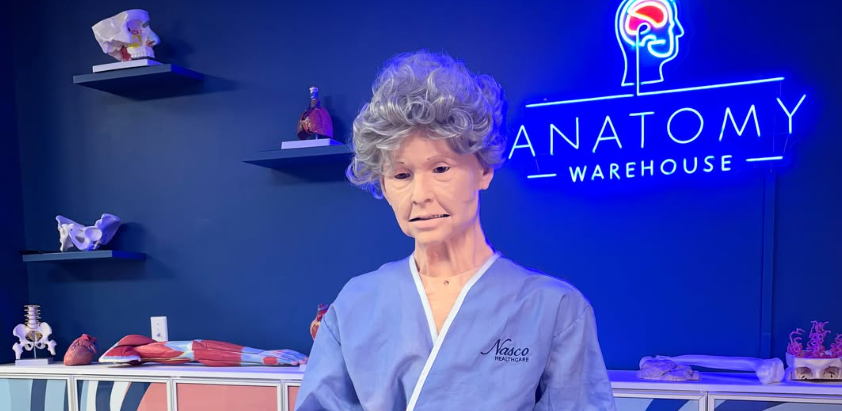
Hey everybody, Mike here with Anatomy Warehouse and I have a special guest here today, Melissa Dahmer from NASCO Healthcare, and we'll be going over the Terry and Danny mannequins. We don't have Danny here with us today, but they're pretty much all built on the same. It's just Danny looks young, Terry looks old.
Melissa:
Terry is elderly appearing, Danny is our young appearing nursing skills mannequin.
Mike:
Perfect. Well, tell us a little bit about, yeah, I guess why these products exist.
Melissa:
For sure. So we all know that educators are bound by many, many things, lots of rules, different reasons why they're educating. This is a nursing skills mannequin.
It's based off of our original Jerry Carey mannequin that had been on the market for a really long time, but we've updated them to have a more realistic feel and appearance.
Mike:
Love that skin sound.
Melissa:
To appeal to the younger generation, the new wave of students that are learning to do patient care.
Mike:
Definitely. So we've got a couple of questions for you today. And first, what we've got is, so what prompted NASCO Healthcare to want to make an update to the Carey and Jerry, which were the first versions?
Melissa:
So Jerry and Carey had been on the market for a really long time, probably somewhere around the late seventies is when those came to market.
Mike:
That was before I was born.
Melissa:
Well, I'm still cool. I was born in the seventies, but, you know, so the late seventies, still a cool era, but definitely time to make an upgrade, make some changes, ensure that students have those competency-based skills that are pertinent towards learning and advancing in their careers. So Jerry and Carey were very loose jointed versus Terry and Danny that have weighted joints that allow for a range of motion.
They also have this lovely skin appearance that has a much more realistic looking skin appearance to an actual patient. They are easier to manipulate as far as rolling and turning. So for any of those bed mobility style, making an occupied bed, things like that are much more realistic with a larger, more realistic looking patient.
Mike:
Yeah. I would say, I remember when I've unpacked Carey for the first time, I was like, oh, those are joints you can see. But now we've got this awesome skin covering on there and it just looks a little more natural.
Yeah.
Melissa:
Correct. Correct. And she functions a bit more naturally as well.
So again, those weighted joints that do give that more realistic range of motion and the ability to turn reposition and make an occupied bed a much more realistic presentation so that students are ready to hit the ground running.
Mike:
Does her head fit standard sized wigs?
Melissa:
Yeah. So we do send some very standard hair along with the training mannequin, the gray wig for the elderly mannequin, the brown wig or brunette wig for the young appearing mannequin. I think there's even some additional wigs that we send that have some highlights, a chunky lob.
We've got some different appearances, but a standard wig would go just perfectly fine for any of the training mannequins.
Mike:
Awesome. So I guess what was one of the number one feedbacks that you got from people that were end users of the Carey and Jerry line? I guess, what was like their biggest takeaway from that?
Melissa:
Yeah. So that the mannequin was functional and it did all the right things, right. But students would come in and go, oh, it's, you know, the bed mobility or, you know, making an occupied bed skills day based on mannequin laying in the bed.
And they could tell that it's mannequin versus something that's more realistic looking, something that's easier to keep clean, neat and tidy as well. So the silicone based skin also presents itself to be a lot easier to maintain and clean. It's durable and rough.
So even rough handling or mistreatment of the training mannequin can withstand our five-year warranty.
Mike:
Awesome. Five-year warranty, guys.
Melissa:
Yeah. Five-year warranty.
Mike:
So tell me a little bit about these bits that are laid out over here.
Melissa:
So the next part of what Terry and Danny, the next level past Jerry and Carey include are some of these pretty features that you see on the table here. So sleeves for the feet that indicate a level of indentation for edema training. So they just fit and slide right on top of the foot.
Or if you wanted to slide it up onto the shin area of the mannequin, you could absolutely do that, too. But they do offer different resistances so that somebody can learn the difference between the different styles of edema for edema training. Yeah, they're nice.
And then they're easy, right? So they slide on, they slide off. So it makes it time saving and for the consumers to do what they need to do, the students to do what they need to do, and then they can move on to the next task, making it easy to change and making it easy to practice different skills within the same training mannequin.
The next set of circles that you see on the table, there are different stages of wound care. So those slide into the other heel sleeve. So again, the ease in which students and instructors can maneuver from edema training, bed mobility, to why would I position a patient in a certain way so that their heel or their ankle is not pressed up against that bedside?
Very important. So those are another easy way to simulate something that happens pretty frequently. Whether it's on the ankle or on the heel, the instructor can move independently into something new while the students are practicing maybe other skills.
And then they can say, oh, well, now we have this issue. What are we going to do about this? So again, that next step thinking in some of those very base level skills that students require when they actually deal with real people, right?
Mike:
Definitely. Yeah. And I love how easy it is to switch these out.
Melissa:
Yeah.
Mike:
Very easy and simple.
Melissa:
Super easy and simple. And it gives an added realism that the actual patient can be experiencing.
Mike:
Definitely.
Melissa:
The genitals. So the Terry-Danny mannequin line, same as the Jerry-Carrie mannequin line, has the interchangeable genitals. So Terry and Danny can be male or female, same as Jerry and Carrie were male and female.
Now what Terry and Danny add are a bit of realism when it comes to the softness in which the genitals can be manipulated. The male glands also comes with an extra skin so that you can simulate that circumcised or uncircumcised glands. There's also a set of prostates that are included with the male genitalia and then a set of cervixes for the female genitalia.
Both parts can be catheterized. So there is urethral space in there. There's also an interchangeable bladder tube.
So I'm going to pull this out and hopefully not wreck your... It's okay. There we go.
An interchangeable bladder tube. Now that is connected internally to the mannequin. And then there is a small port on the side so that the fluid supply bag can be supported externally to the mannequin, creating a lot less mess when it comes to some of those training practices.
So again, those genitals are easy to slip in and out of the underbody of the mannequin. And the tube is interchangeable between the male and the female genitals.
Mike:
Perfect.
Melissa:
Yeah. The female genital adds an additional space. So where the prostate would be inserted in the female genital, you've got an additional fluid supply bag for enema training practice.
So there's one of those cervixes that pop in and pop out. This is where that bladder tube would go. Right in here.
And then it connects internally to the mannequin and then subsequently enema training in the female genital. But on the backside of the male genital, we've got a space for those prostates. So those prostates are going to slide right in there.
And then again, that similar bladder tube is going to go right in the back of that male genital.
Mike:
Seems pretty easy to me.
Melissa:
Yeah. Very, very easy. Very simplistic.
And again, there's a Y connector internally to the mannequin so that this bladder tube can be connected internally. There's a space on the side here for that fluid supply to come into the mannequin. And then there's a Y connector internally to connect not only to the genital, but also to the suprapubic space.
So again, an additional change between the Geri-Keri mannequin line is the addition of that suprapubic spot, the addition of the prostates, the addition of the cervixes, addition of the heel ulcers, the edemia training, and the ease and simplicity of the training mannequin all around. Still has great features for gastrostomy, ileostomy, and colostomy. And then again, all the weighted appendages and great physical features of the training mannequin.
Mike:
Are there any add-ons that someone could purchase separately to enhance this?
Melissa:
Yes, absolutely. So we've recently released the next generation of Terry and Danny. That includes a software platform, same body style, same mannequins, but a software platform that will allow the students to practice different things.
Different blood pressure changes, different ways in which we monitor any kind of blood gas analysis of laboratory values. There's a glucometer, a simulated glucometer. There's a simulated AED so they can perform chest compressions and shock the mannequin.
They can rate the quality of their CPR. So we have that. There are different levels of Terry and Danny too that include auscultation.
So you can hear the heart and lung sounds. In the next gen, I believe there's bowel sounds as well. And then in the very top level, you can have even an immersive style room where there is feedback being gathered for all the different skills that the student is performing in conjunction with the mannequin.
So again, another simple way in which the instructors are able to capture data, make sure that students are accurately performing any kind of skills assessments, and then pushing that forward into their CRM to capture all of that student data so that their students are feeling compliant and competent in their ability to perform skills.
Mike:
Very important. Yeah. Yana, it seems like you guys have a little bit of everything for every level of education.
What are the most popular programs that use Terry and Danny?
Melissa:
Great question. So we see Terry and Danny from your kindergarten through 12th grade CTE-style level schools, so your very base level kids that are eager and wanting to learn about what a career in health care might be, all the way up to university level registered nurses, LPNs. You see a little bit of integration in pre-hospital emergency care programs.
So because she can have a fully compressible chest, there is CPR feedback, a full intubatable airway through her mouth and through her nose. You do sometimes see a little bit of this training mannequin in those pre-hospital emergency systems. So like EMT for basic or paramedicine because you have the ability to do an IV and some other practice that way.
And the fact that it's light and it's portable, right? So the ability to take the mannequin from point A to point B is very simplistic and easy. You can simulate a really cool training in a bathroom or in a simulated living room or in other places.
Maybe somebody has fallen out of their car, you know, so she's light and positionable and it's easy to get her from point A to point B. And then you can practice all those skills too.
Mike:
That's awesome. Yeah, there's so many. I think last question is, is there anything else that you'd want to say anything about these or I guess something that we haven't covered already?
Melissa:
I think, you know, there's a great opportunity for the skills trainer in multiple levels. And I think the continuacy is very important. So the ability for a young student to go, oh, I've learned, you know, X, Y, and Z about this training mannequin.
And then they're setting foot on their university campus because they're pursuing a career in health and they're seeing the same training mannequin, maybe in a different way. Maybe they've got the Terry Pro and the Terry Pro has blood gas and has ability to shock and has some additional monitoring. Or maybe they're in a full immersive suite where they're now fully immersed into a room, into an emergency style room.
And they're performing all the different things. They're paying attention to monitoring that might be beeping, you know, and they're following all those parameters. I think the method in which we learn is really important.
So when we see things and when we're able to touch things and manipulate things, we learn a lot better when we're exposed to, you know, training mannequins and the human body in different conditions that the human body can experience. Young people, I think, move forward into a career in health a lot easier. And then as we fully immerse ourselves into a platform, I think the immersive suite kind of captures it all and then makes it easy for instructors, right?
So those instructors are busy checking all the boxes and making sure all the skills, the immersive technology that's included with the Terry and the Danny mannequin that captures all of that for you. So it's capturing everything and populates a nice, lovely report that instructors can use to perform and push out all that student data.
Mike:
They can focus on the competencies. Yeah. Exactly.
I did actually think of one more. If I bought the more basic Terry, could I upgrade her with features?
Melissa:
At this time, no. So what we could do is we cannot change from, so we could change from like a patient skills Terry to a Terry that has a little bit more to it, but we cannot change from a basic Terry or Danny up into the immersive Terry or Danny. So because of the different hardware that's internal to the mannequin that allows for the mannequin to talk to the software platforms, you know, we would have to make a change.
Sure. Yeah. The body would more or less be the same.
What's internal to the mannequin is what changes. Got it.
Mike:
Okay. Yeah. Beautiful.
Well, thank you, Melissa, for coming by and showing us what Terry was all about. And I want to thank you everyone for watching. You can buy Terry and Danny on our website today.
They're available. If you have any questions, reach out to our sales team and they'd love to go over a demo with you or even any product questions. We can even get you a video call with Melissa herself to go over any questions that you had to yourself.
Thank you.
Share: