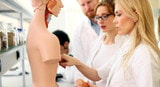

Task Trainers vs Anatomy Models: What Your Program Needs
Nov 13th 2026
Stocking a nursing skills lab or an anatomy classroom starts with two catalog categories that look alike. Anatomical models and task trainers both recreate the human body, and both belong in health science education. They do very different jobs, though. Models help students study the body. Task trainers help students practice on it.
That distinction matters for every program, and it matters most when budgets are tight and shelf space is limited. A program with only models produces students who can name every structure but have never handled a catheter. A program with only task trainers risks the reverse. Most programs need both, and the real question is the mix. Below, we explain what each category teaches, where the two overlap, and how to plan the right balance for your students.
What Do Anatomical Models Teach?
An anatomical model is a physical, three-dimensional replica of the human body or one of its parts. Students use models to learn what's inside the body, where each structure sits, and how it relates to its neighbors.
It's a broad category. Anatomical models for teaching include full skeletons, dissectible torsos, individual organs, joints, and cross-sections of specific systems. Some models are life-size, and others enlarge small structures so they're easier to see. Many come apart into numbered pieces that match an included key or guidebook.
Physical models earn their place through touch. A student can turn a heart over in their hands, lift out a section, and see how the chambers connect. Taking a model apart and putting it back together builds spatial understanding that a textbook diagram can't. The structure stops being a flat image and becomes something the student has held. For more on this, read our post on anatomy models vs digital learning.
A laryngeal and cardiopulmonary model is a good example. It presents the larynx, trachea, heart, and lungs as one connected system, so students see how breathing and circulation share the chest.
What Do Task Trainers Teach?
Task trainers build hands-on clinical skill. Each one recreates a specific body region, such as an arm, a torso, or a pelvis, so students can perform a procedure on it again and again.
The goal is muscle memory, not memorization. A student practicing IV insertion learns how a vein feels under the fingertips and how much pressure it takes. A student practicing wound packing learns how deep to go and how firmly to pack. That feel for tissue resistance, landmarks, and hand position comes from repetition on something physical. Task trainers give students that repetition before they ever work with a patient. That makes them a core part of clinical skills training for nursing students, medical students, and other future clinicians.
The best task trainer for basic clinical skills is the one that matches the procedures your curriculum actually tests. Common starting points include injection pads, IV and phlebotomy arms, catheterization models, and wound care trainers.
A thoracentesis and chest drainage trainer shows how focused a task trainer can be. Students practice needle insertion and chest drainage on a realistic chest, building the precision these procedures demand. For a closer look at the category, read What Is a Task Trainer?
How Do Models and Task Trainers Compare?
The simplest way to tell them apart is by what the student does. Students study a model, and they practice on a task trainer.
|
Anatomical Models |
Task Trainers |
|
|
Primary purpose |
Show structure accurately |
Rehearse a specific procedure |
|
What students do |
Examine, disassemble, and identify |
Palpate, insert, suture, and repeat |
|
What it builds |
Anatomical knowledge |
Clinical skill and muscle memory |
|
Curriculum fit |
Anatomy and physiology, early coursework |
Clinical skills courses, pre-clinical practice |
|
Ongoing cost |
Mostly a one-time purchase |
Replacement skins, pads, and consumables |
Where Do the Categories Overlap?
The line between the two isn't always sharp. Many task trainers include accurate anatomy, because good practice depends on realistic landmarks. An IV arm needs believable vein paths, and an airway trainer needs a correctly shaped airway. Some anatomical models also include parts students can manipulate, such as movable joints.
When a product seems to fit both categories, ask what it's mainly for. If students will mostly look at it and learn from it, it's a model. If they'll mostly perform a procedure on it, it's a task trainer. That test works for nearly any product.
What Does Your Skills Lab Need?
Planning a clinical skills lab starts with your curriculum, not a catalog. Early coursework leans on models, since students need to understand structure before they work on it. Nursing clinical skills training leans on task trainers. Most nursing skills labs run both at once, and the balance shifts as students progress.
A practical approach is to pair a model and a task trainer that cover the same body region. Students study the structure first, then practice the procedure on it. For example, a cardiopulmonary model teaches chest anatomy, and a thoracentesis trainer puts that knowledge to work. An arm model that shows the veins pairs well with an IV arm, and a pelvic model pairs well with a catheterization trainer.
Budgeting works differently for each category. Models are mostly a one-time purchase and last for years with basic care. Task trainers wear with use, so plan for replacement skins, pads, and other nursing lab supplies. Building those costs into your nursing skills lab equipment list up front prevents surprises mid-semester.
Priorities also vary by program. A skills lab for nursing students may start with injections and catheter care. A skills lab for medical students may start with suturing or airway management. Hospital educators and high school health science teachers can apply the same approach at their own scale.
Where Do Manikins Fit?
Full-body manikins belong to a third category. Programs use them for scenario-based training, where students manage a whole patient instead of a single procedure. That work usually happens in a simulation lab, which serves a different purpose than skills lab practice. Full-body medical simulators come in several fidelity levels.
Need Help Deciding?
Not sure which your program needs? The team at Anatomy Warehouse can help you plan the right mix of models and task trainers for your curriculum, budget, and space. Browse our hands-on learning tools today. When you're ready, reach out for support or request a custom quote for a full lab build-out.
Share: